

Dating language can make an ordinary decision feel like a trend you need to master. You may simply want to meet without alcohol, protect time for your own life, or find someone whose values fit yours. Naming that preference can help you explain it. A fashionable label cannot tell you whether a particular person will treat you well.
Start with what you want to do together and what each of you is freely agreeing to. You can enjoy getting to know someone without promising a relationship, sex or a future you have not chosen.
On this page
1. Treat labels as a starting point
People use informal dating terms differently. If someone describes their approach with an unfamiliar phrase, ask what it means to them: “What would that look like when we make plans?” A concrete answer is more useful than assuming you share a definition.
Clarify whether you are discussing an activity, a personal boundary or a relationship agreement. Meeting for coffee describes a date. Choosing not to drink describes a preference. Exclusivity needs a separate conversation. None automatically settles the others.
2. Understand dry dating
Dry dating means going on dates without drinking alcohol. It does not describe a particular attitude toward sex or commitment. Someone may choose it for many reasons, and they decide how much personal information to share.
Try a daytime café, a public exhibition or another accessible activity within both budgets. You might say, “I’m keeping this date alcohol-free. Would meeting for tea work?” Check opening times, transport and accessibility rather than assuming a particular outing suits everyone.
An alcohol-free date still requires respect for physical boundaries. Paying, flirting or agreeing to meet does not create an obligation to be intimate. RAINN explains consent as a voluntary, ongoing agreement that can be withdrawn.
3. Make room for your priorities
You can protect time for friends, parenting, work and rest while dating. Instead of relying on a term such as “prior dating,” explain your availability: “I can usually meet once a week, and I’m interested in a committed relationship if we both want that.”
Ask about the other person’s preferences too. Casual dating, exclusivity and taking things slowly can mean different things. Being honest about your pace gives each person information to make their own choice; it does not require either of you to accept an arrangement that hurts.
4. Talk about shared values
You do not need identical opinions to have a conversation worth continuing. You may, however, need agreement on decisions that shape your life: children, relationship structure, religious practice, money or where to live.
Choose one meaningful topic and ask how it affects everyday choices. “What does sharing household work fairly mean to you?” tells you more than checking whether you use the same political or spiritual labels. If a belief matters deeply to you, you can discuss it respectfully without treating disagreement as a problem you must overcome.
Notice whether you can disagree without ridicule, intimidation or pressure. You are allowed to decide that an important difference makes dating unsuitable.
5. Keep therapy and choice in perspective
A label such as “armchair dating” is no substitute for getting to know someone. Therapy is not an early-date compatibility examination, and a date cannot diagnose you. You do not owe a new acquaintance access to therapy sessions, private records or painful experiences.
If both people want professional help with a relationship concern, discuss the purpose, cost, privacy and each person’s willingness. Participation cannot guarantee compatibility. You can also decline another date without finding a clinical explanation for your decision.
Before continuing, ask yourself: Do I want this arrangement? Have we discussed what it involves? Can I say no or change my mind? Those questions remain useful when the trend names change.
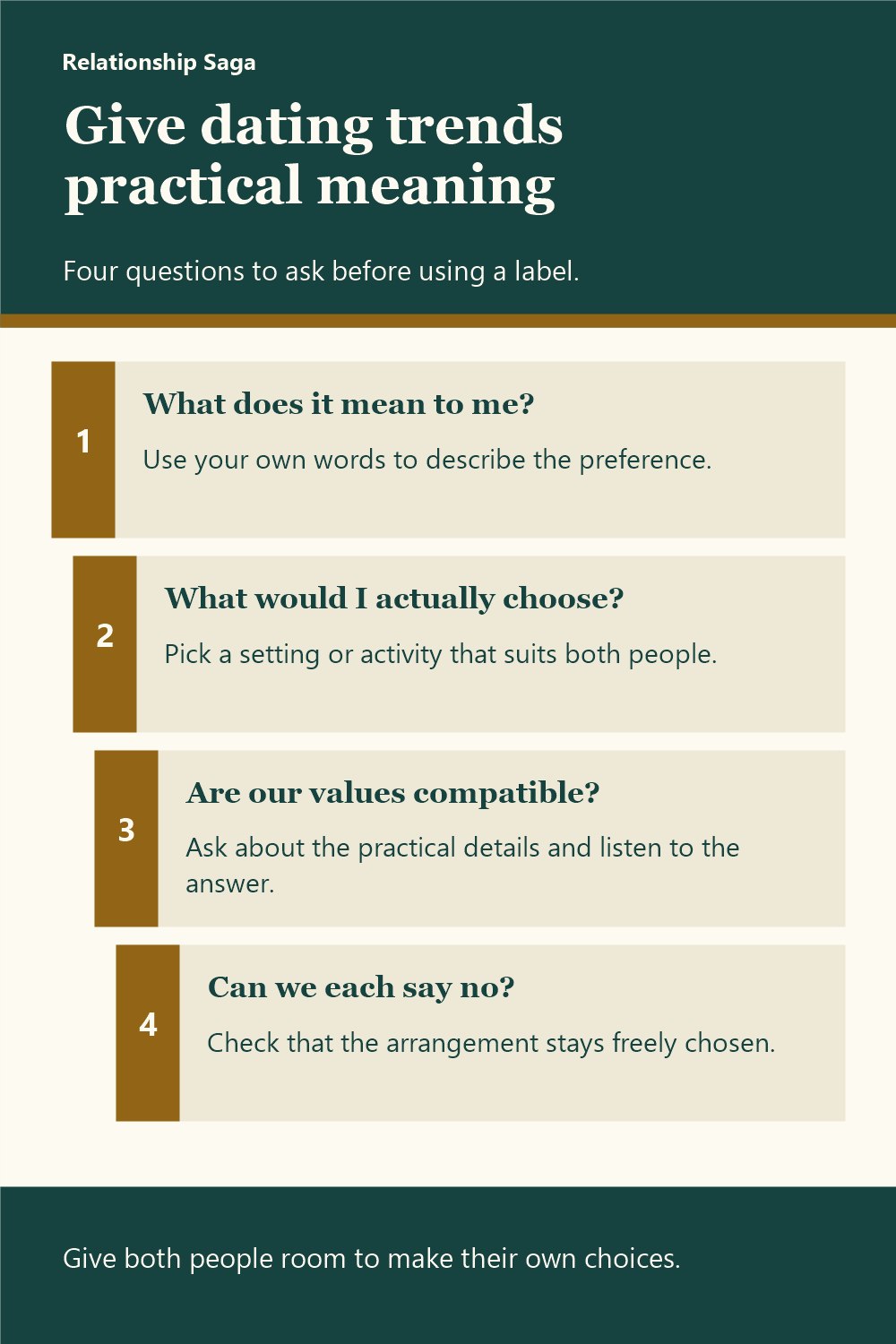
Read the infographic in text
Give dating trends practical meaning Four questions to ask before using a label.
- What does it mean to me? Use your own words to describe the preference.
- What would I actually choose? Pick a setting or activity that suits both people.
- Are our values compatible? Ask about the practical details and listen to the answer.
- Can we each say no? Check that the arrangement stays freely chosen.
Give both people room to make their own choices.