

Self-esteem concerns the way you value and regard yourself. A difficult period can make your inner voice harsher or leave you looking for reassurance. You do not need to become endlessly confident before you deserve care, respect or a relationship in which your needs matter.
In a relationship, it helps to separate your view of yourself from the way another person chooses to behave. Low self-esteem cannot tell you whether someone loves you, explain away mistreatment or make you responsible for healing a partner.
On this page
Notice how you talk to yourself
Start with a particular moment rather than a verdict about your whole character. “I felt embarrassed when that conversation went quiet” gives you something to explore. “Nobody could ever enjoy being with me” turns an uncertain interaction into a sweeping conclusion.
Ask what you know, what you are assuming and what you would say to a friend in the same position. You can acknowledge a mistake without deciding it defines you: “I interrupted. I can apologise and listen more carefully next time.” A balanced response should feel believable; you do not have to replace every painful thought with an enthusiastic slogan.
The NHS guidance on raising low self-esteem includes noticing negative beliefs, questioning them and recognising strengths. Try one approach that feels manageable rather than treating confidence as another standard you must meet perfectly.
Build confidence through manageable choices
Choose something within your influence: practise a skill for a few minutes, ask a question you have been postponing or make time for an interest you enjoy. An activity can matter because it suits your values, even when nobody notices or praises it.
Keep the aim small enough to fit your circumstances. Caring duties, disability, money and exhaustion can change what is possible today. If a plan was too demanding, adjust it. Needing help or taking longer is not proof that you are incapable.
You might note a few concrete examples of effort, fairness or persistence. Include times you asked for support, rested or changed your mind after learning something. Your worth does not rise and fall with productivity, appearance or a partner’s attention.
Ask for support without making reassurance a test
A clear request gives someone a chance to understand what you need: “I am doubting myself after that meeting. Could you listen for a few minutes?” Or, in dating: “I would like to know whether we both want an exclusive relationship.” Asking directly is more useful than setting hidden tests or trying to decode every message.
Reassurance can be welcome, but one person cannot remove every doubt. Discuss what support each of you can reasonably offer, including when you are unavailable. A reply that comes later than you hoped does not by itself establish rejection. Equally, repeated dismissiveness deserves attention even if the other person occasionally says something reassuring.
Keep connections and interests beyond the relationship where possible. You can receive care from friends, family, a community or a professional without asking a partner to be your only source of support.
Keep respect and responsibility in view
Insecurity does not give either person permission to control passwords, monitor movements, insult someone or demand constant proof of love. Talk about the action itself and its effect. You do not need a diagnosis or certainty about a motive to say that a behaviour is unacceptable to you.
If your partner struggles with confidence, you can listen and encourage them to find support. They remain responsible for how they treat you. You do not have to tolerate jealousy, repeated dishonesty or pressure in order to prove that you care, and you cannot promise that enough reassurance will change those patterns.
When a conversation feels safe, ask for a specific change and consider whether it happens consistently. If raising a concern brings threats or intimidation, prioritise private support and safety rather than trying to deliver the perfect explanation.
Make room for help and your own decisions
Persistent self-criticism can be difficult to handle alone. Consider speaking with a qualified healthcare professional if it is affecting daily life, relationships or the choices you feel able to make. You can describe what has been happening without arriving with a label for yourself.
You are allowed to consider what a relationship offers now, including care, reliability and freedom to disagree. You do not need to fix your self-esteem before setting a limit, leaving an unsuitable situation or asking for more information. A useful next step may be small: one honest request, one supportive conversation or one decision that reflects your own needs.
Read the infographic in text
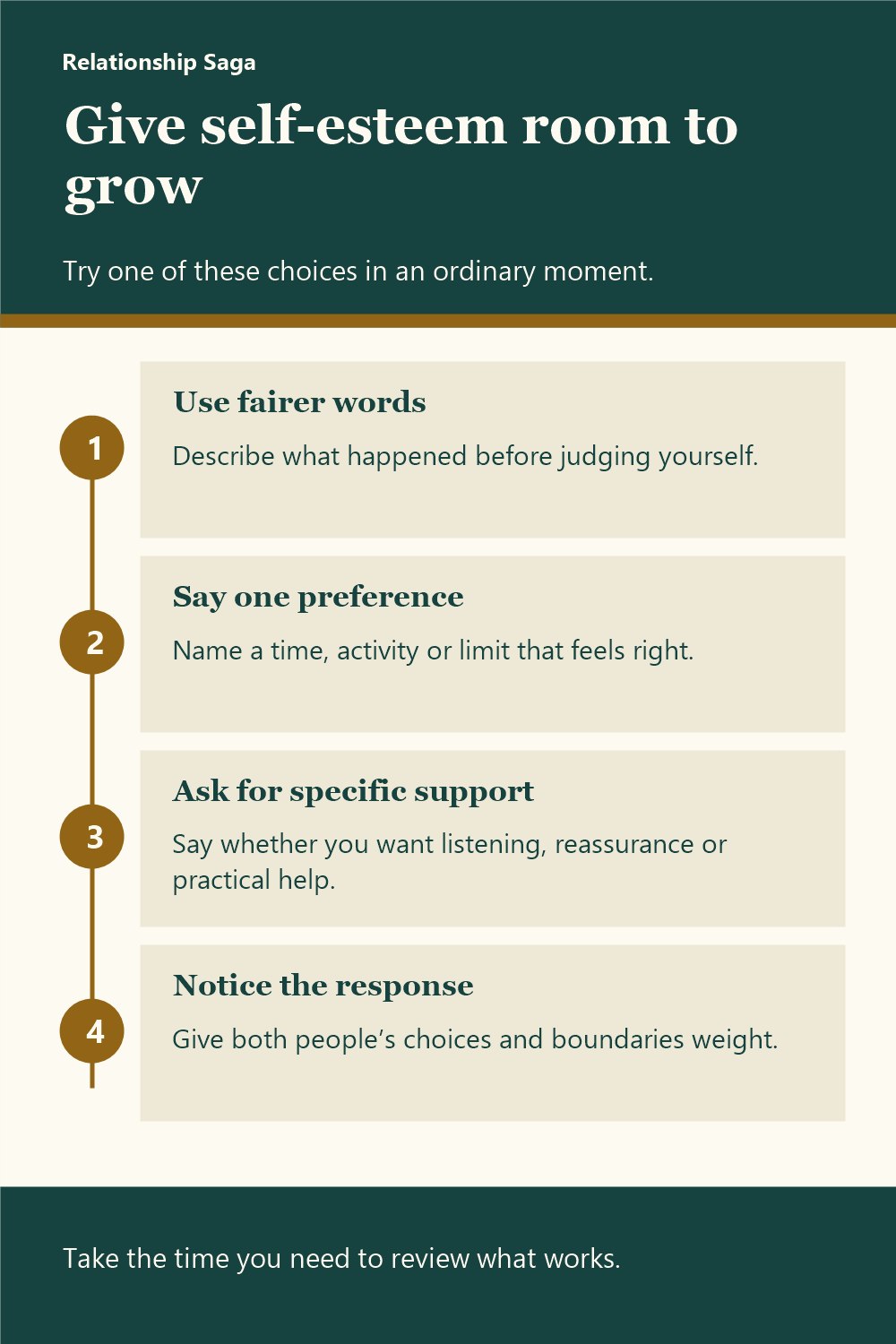
Give self-esteem room to grow Try one of these choices in an ordinary moment.
- Use fairer words Describe what happened before judging yourself.
- Say one preference Name a time, activity or limit that feels right.
- Ask for specific support Say whether you want listening, reassurance or practical help.
- Notice the response Give both people’s choices and boundaries weight.
Take the time you need to review what works.