

Hearing “I love you” from someone who does not want a relationship can leave you unsure what to do. The affection may matter to you, but it does not by itself establish a shared commitment. You need to know what kind of relationship, if any, you are both choosing.
You do not have to solve his motives before considering your own needs. Start with what he says is available, how he treats you and whether the arrangement is one you want. You can care about him and still decide that it is unsuitable.
On this page
1. Separate feelings from agreements
Someone may care about you and be unwilling to form the relationship you want. You do not have to decide whether the feeling is “real love” before recognising that difference. A relationship needs mutual participation, rather than enough feeling from one person to cover for both.
Casual dating, friendship and committed partnership can each be valid choices when everyone understands and freely agrees to them. A casual arrangement is not automatically dishonest. Problems arise when expectations are concealed, agreements are broken or one person keeps accepting something they do not want.
A lack of romantic commitment does not establish that your appearance, personality or finances are defective. Attraction and compatibility are individual, and you may never get a complete explanation. Avoid turning the situation into a list of changes you must make to earn his choice.
2. Clarify the arrangement
Name what matters to you: “I want an exclusive relationship with regular time together. Is that something you want too?” You can discuss values and future plans without assuming that every difference makes happiness impossible. The question is whether important differences can be handled in a way you both accept.
If he mentions past hurt, listen without taking responsibility for repairing it or promising to wait until it disappears. You can be compassionate and ask what he is able to offer now. His history does not prove he can never trust again, nor does it promise that your patience will change his decision.
If there are concerns about an ex, ask about the present situation and any agreements that affect you. Old photographs or occasional contact do not reveal the whole relationship. You do not need access to his accounts or private messages to decide that the uncertainty is more than you want.
Ask directly about exclusivity rather than assuming it. Dating other people can be consistent with a clearly agreed non-exclusive arrangement. Concealing that contact or breaking an exclusivity agreement is a different issue. Decide what you are comfortable with and let the answer inform your participation.
3. Look at behaviour without guessing motives
Notice whether he respects your decisions, keeps agreed plans and speaks honestly about the relationship. You can describe an effect without claiming to know an intention: “Last-minute invitations do not work for me” is clearer than trying to prove why he sends them.
A pattern may be unsuitable even when there is no dramatic wrongdoing. Affectionate messages followed by little time together may leave you disappointed. You are allowed to want more reliable contact without proving he is deliberately keeping you as an option.
For more on trust, consistency and personal space, see love is respect’s emotional-boundaries guidance. Compare what has been said with what is happening, while leaving room for context and clear discussion.
Sex does not create a commitment that has not been agreed. You can choose whether sexual contact still works for you, ask about sexual-health precautions and stop at any time. Affection, earlier consent or fear of losing contact never creates an obligation to continue.
4. Choose boundaries around contact and support
Company can be enjoyable even when people want different futures. Ask whether the current visits and conversations suit you. You might decide that occasional company is welcome, or that it keeps a hope alive in a way that hurts. Either conclusion can guide a boundary.
Jealousy does not prove commitment, and making someone jealous is not a useful test of love. He does not gain control over your friendships or dating choices by expressing affection. Discuss any mutual agreements clearly, and pay attention if requests become pressure, monitoring or threats.
Friendship is optional. If you want time apart before considering it, say so: “I am not ready for friendship while I still want a relationship.” You cannot promise how your feelings will change, and you do not need to accept friendship to show maturity or kindness.
Keep financial help separate from the hope of commitment. Before paying for something or lending money, consider whether you can afford it and whether you would choose to do it without expecting a relationship in return. You can decline a request without establishing that he is using you.
5. Decide what works for you
Consider the arrangement as it is now, rather than only its best possible future. If nothing changed, would you still choose it? You can take some time to think, but you do not have to stay available until he makes a decision.
If you want to end romantic contact, state your choice: “I care about you, but I want a relationship and we want different things. I am stepping back.” Make a practical plan for belongings, shared responsibilities and future messages. If you fear his reaction, seek trusted or specialist local support before changing contact.
Sadness after stepping back does not make your needs unreasonable. Give yourself room to miss him, keep supportive connections and decide what contact helps you move forward. You do not need to make him prove his worth or find someone else immediately. Your next choice can simply reflect what you are willing to take part in.
Read the infographic in text
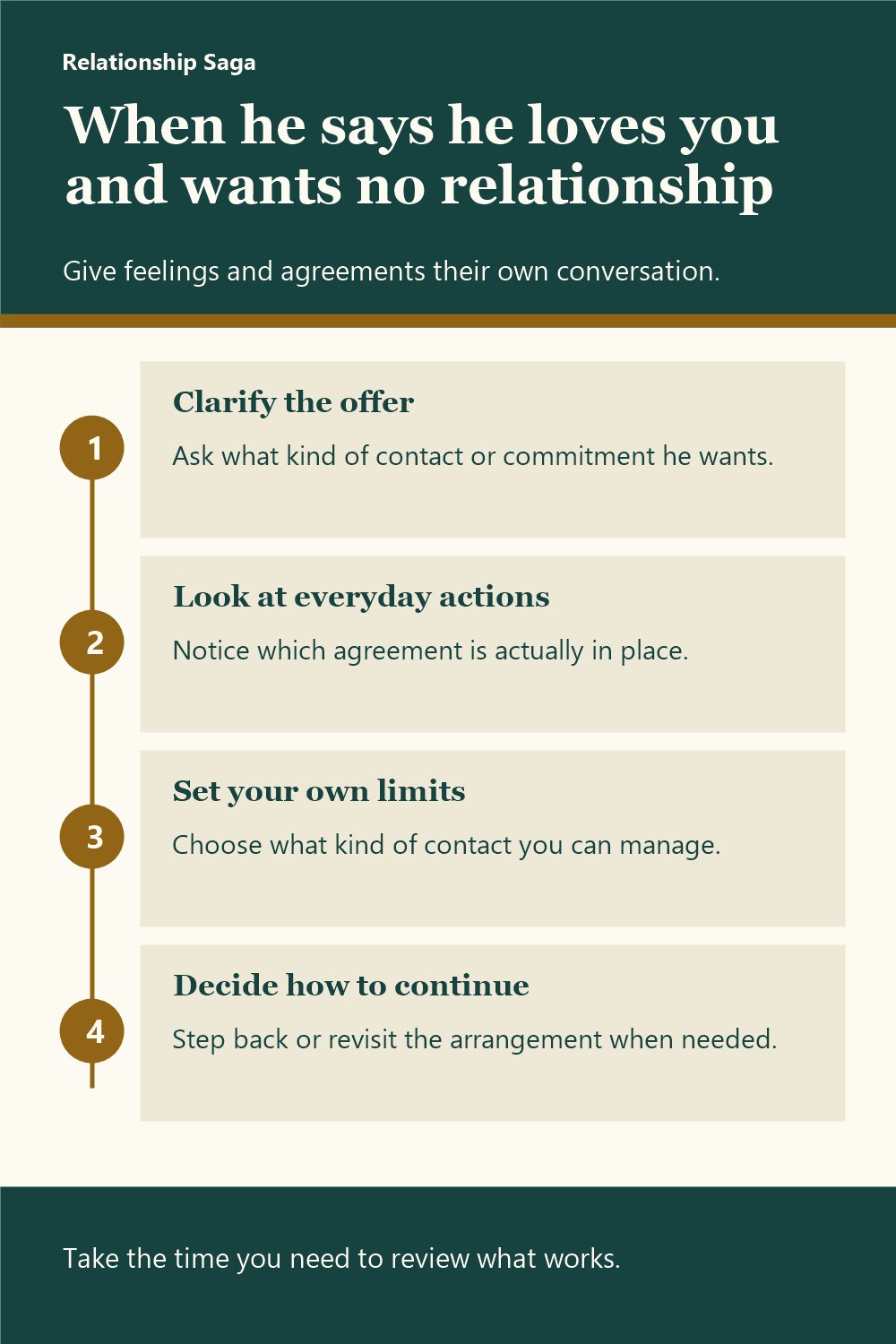
When he says he loves you and wants no relationship Give feelings and agreements their own conversation.
- Clarify the offer Ask what kind of contact or commitment he wants.
- Look at everyday actions Notice which agreement is actually in place.
- Set your own limits Choose what kind of contact you can manage.
- Decide how to continue Step back or revisit the arrangement when needed.
Take the time you need to review what works.