

Love can add companionship, affection and practical support to your life. A relationship does not need to make you feel permanently happy or provide every part of your identity. Two people can care deeply for each other and still need friends, privacy, rest and help from elsewhere.
Rather than judging the relationship by how intense it feels, look at everyday arrangements. Can both people make choices, discuss a problem and expect basic respect? These questions are useful whether the relationship is new or has lasted for years.
On this page
Describe what care looks like in daily life
People express affection differently. Ask what the gesture means to the person receiving it rather than assuming gifts, frequent messages or physical affection will meet every need.
Care might mean listening after a difficult day, checking an appointment time, sharing a task or respecting an evening alone. A small reliable action can be more useful than a large promise that is repeatedly forgotten.
You might ask: “What has helped you feel supported this week?” and “Is there something we should arrange differently?” These are invitations to understand each other, not a demand that someone produce a grateful answer.
Make room for two whole people
A partner can matter greatly without becoming your only source of purpose or support. Keep room for friendships, interests, cultural connections and professional care where needed. Different people and communities can meet different needs.
Love is respect’s guidance on emotional boundaries includes consistency, individual decisions and time apart. Privacy can coexist with honesty; a close relationship does not require sharing every password, private thought or other person’s confidence.
You can also enjoy closeness and need reassurance. These suggestions for balancing reassurance, connection and space offer practical ways to discuss that need without restricting another person.
Share the practical work of being together
Affection does not automatically divide household tasks, caregiving, planning or expenses. Make the work visible and consider each person’s time, health, resources and existing responsibilities.
- Name a recurring difficulty, such as one person making every plan.
- Agree who will handle the next specific task.
- Clarify what “done” means and when it is needed.
- Choose a time to review the arrangement.
Fairness does not always mean doing identical amounts. Someone with an illness may need more help; a partner working long hours may have less time. The aim is a workable agreement that includes both people’s needs, with outside support if the load is too much.
Use a conversation that leads to an arrangement
Describe a specific event and a request: “When the visit was arranged without checking, I lost the evening I needed to rest. Please ask before inviting people over.” This gives more direction than a judgment about whether someone truly loves you.
Listen to their account, then check what you have each agreed. If either person is too upset to continue respectfully, a pause can help, with a realistic plan to return. A pause should not become punishment or a way to avoid the issue indefinitely. Read more about communicating in your relationship if you want to plan the discussion.
Physical affection and sex also require mutual willingness. A loving relationship does not create a duty to perform affection on demand. If needs differ, discuss them without threats, pressure or promises that a particular activity will repair the relationship.
Review problems without assuming love can fix everything
Apologies matter when they lead to responsibility and sustained changes. Time alone does not resolve repeated dishonesty, incompatible plans or harmful conduct. Nor does forgiveness require renewed trust, continued contact or staying together.
Ask whether the relationship makes room for disagreement and whether the practical pattern is improving. Counseling may be useful when both people can participate freely and safely. If there is fear, intimidation or coercive control, seek individual domestic-abuse support instead of relying on a joint conversation.
You may choose to continue, renegotiate or leave. Ending a relationship does not prove that either person failed to work hard enough or that the affection was never real. A realistic next step can include getting help to consider your options, rather than making a final decision today.
Read the infographic in text
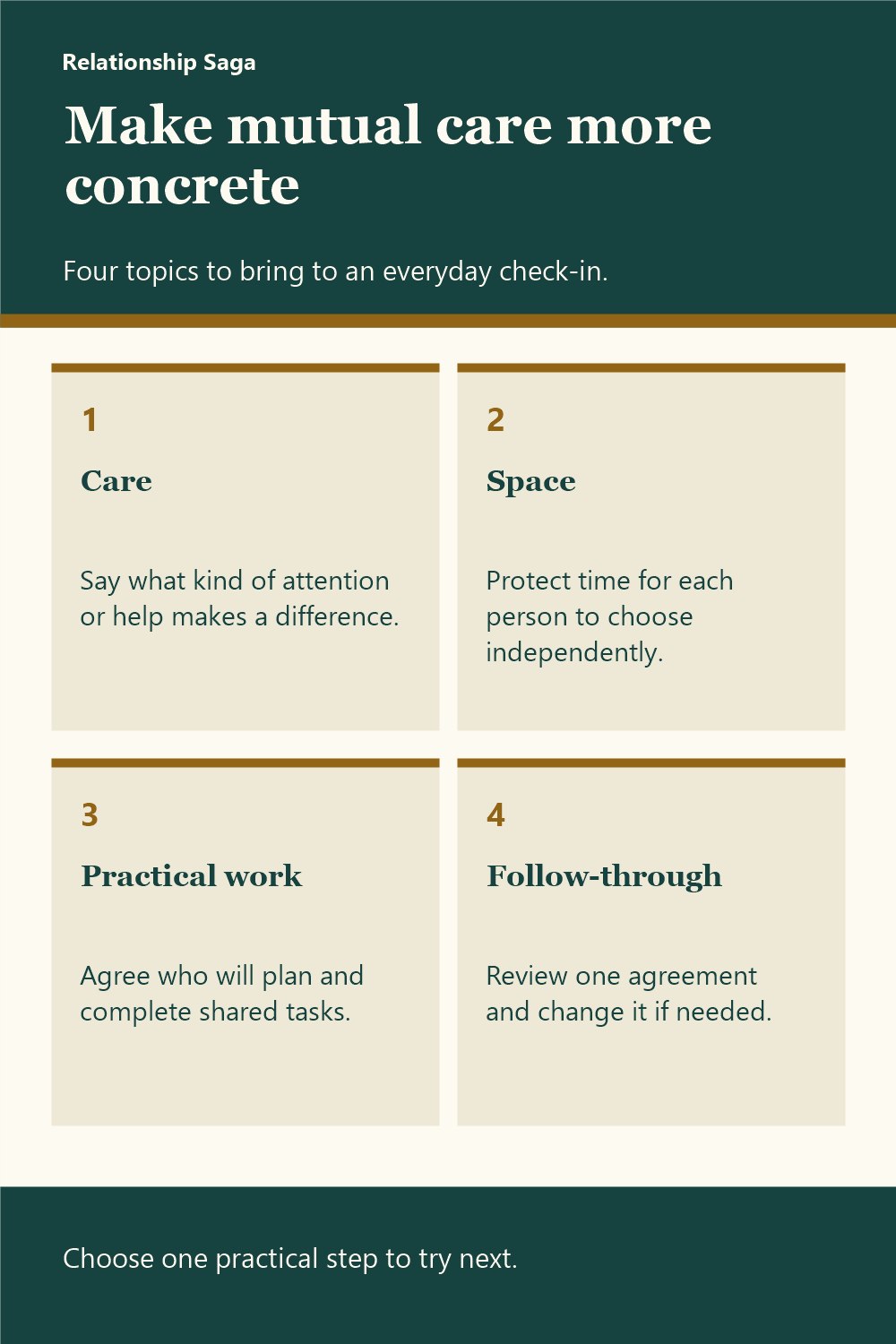
Make mutual care more concrete Four topics to bring to an everyday check-in.
- Care Say what kind of attention or help makes a difference.
- Space Protect time for each person to choose independently.
- Practical work Agree who will plan and complete shared tasks.
- Follow-through Review one agreement and change it if needed.
Choose one practical step to try next.