

Wanting reassurance or more time together does not make you a bad partner. The useful question is how you respond to that need and whether the relationship offers room for both people’s preferences. Affection, uncertainty and a wish for space can exist in the same relationship.
Focus on a specific pattern rather than calling yourself “clingy.” Perhaps you repeatedly send messages after no reply, cancel your own plans to stay available or feel unable to ask directly for the contact you want. You can work on a behavior without turning it into your whole identity.
On this page
Describe the pattern without guessing its cause
Notice what happened before the urge for reassurance, what you did and what followed. “They had not replied by evening, so I sent several messages” gives you something concrete to consider. “I ruin relationships” does not.
Wanting contact does not establish that you have experienced trauma or have a particular attachment style. An online quiz cannot explain every reason for a relationship difficulty. You can ask for professional support without first choosing a label.
Look at the relationship’s actual context too. Repeated dishonesty, broken agreements or dismissive responses deserve attention. Trust is not created by forcing yourself to ignore what has happened or pretending that everything is safe.
A partner remains free to choose the relationship. Giving them space is not a test to see whether they return, and increased independence cannot guarantee that someone will stay. Focus on arrangements you can both freely accept.
Make a request that leaves room for an answer
Try: “I would like more predictable contact. What is realistic for you during the workweek?” Explain what would help and listen to their capacity. There is no universal requirement to call daily or meet a fixed number of times.
Ask about physical closeness separately. A person may welcome a conversation and prefer less touch, or enjoy affection while needing quiet time. You can express disappointment respectfully while accepting a no.
Reassurance does not justify demanding passwords, tracking location, restricting friendships or pressuring someone to answer immediately. If you have done these things, stop the controlling behavior and seek help taking responsibility. These ideas on responsibility after emotional abuse may be relevant.
Agree on how to handle time apart when possible. A practical message about availability is different from disappearing for days to teach someone a lesson. Review an arrangement if it leaves either person continually waiting or pressured.
Pause before repeating a message
When you notice the urge to send another message, ask whether there is new practical information to share. If there is not, consider a manageable pause and an activity that does not depend on the reply.
Name the feeling without treating it as proof: “I feel anxious, but I do not yet know why they have not replied.” Check the explanation later through a conversation rather than repeated accusations or online monitoring.
You can offer yourself a fairer response: “I want connection, and I can ask clearly.” Needing reassurance is not shameful, and a partner’s delay does not establish your value. Nor must you dismiss a repeated pattern that does not meet your needs.
These suggestions for communicating in your relationship can help you move from guessing toward a direct request. A conversation may reveal a difference that needs a decision, rather than a misunderstanding you can simply solve.
Keep support and interests beyond the relationship
Make room for people who matter to you, whether that means a friend, relative, community group or professional. No single partner needs to be your only source of company, help and understanding.
Choose an activity because you value it, not to appear unavailable. A hobby, familiar routine or small personal goal can have meaning even while you still miss your partner.
Time alone can be comfortable, difficult or a mix. Start with something manageable if you want to practice it. You do not have to enjoy isolation or force yourself to travel alone as proof of independence.
Independence can include accepting help. Disability, illness, money pressures and caring responsibilities may affect what support you need. Depending on assistance does not remove your right to respect or make you responsible for another person’s harmful behavior.
Discuss practical help rather than assuming what another adult needs. Ask what would be useful, say what you can offer and keep room for each person’s choice. Caring does not require taking over every task.
Review whether the relationship and support are working
Ask what you need now: a clearer agreement, a response to broken trust, practical assistance or individual professional support for persistent distress. Those needs may overlap. They cannot all be solved by sending fewer messages.
You can change the pace of a new relationship or decide that ongoing contact expectations do not fit. Mutual choice matters more than proving you can tolerate any arrangement. Read about attraction and a connection that is freely returned.
Both people need room to make decisions and maintain other relationships. If you fear retaliation, threats or isolation, seek individual safety advice rather than treating the situation as a personal confidence exercise.
Look for changes you can observe: clearer requests, respected limits and less pressure on either person. You do not need to become completely self-reliant or never feel anxious. The aim is a way of relating that respects both people, with support when needed.
Read the infographic in text
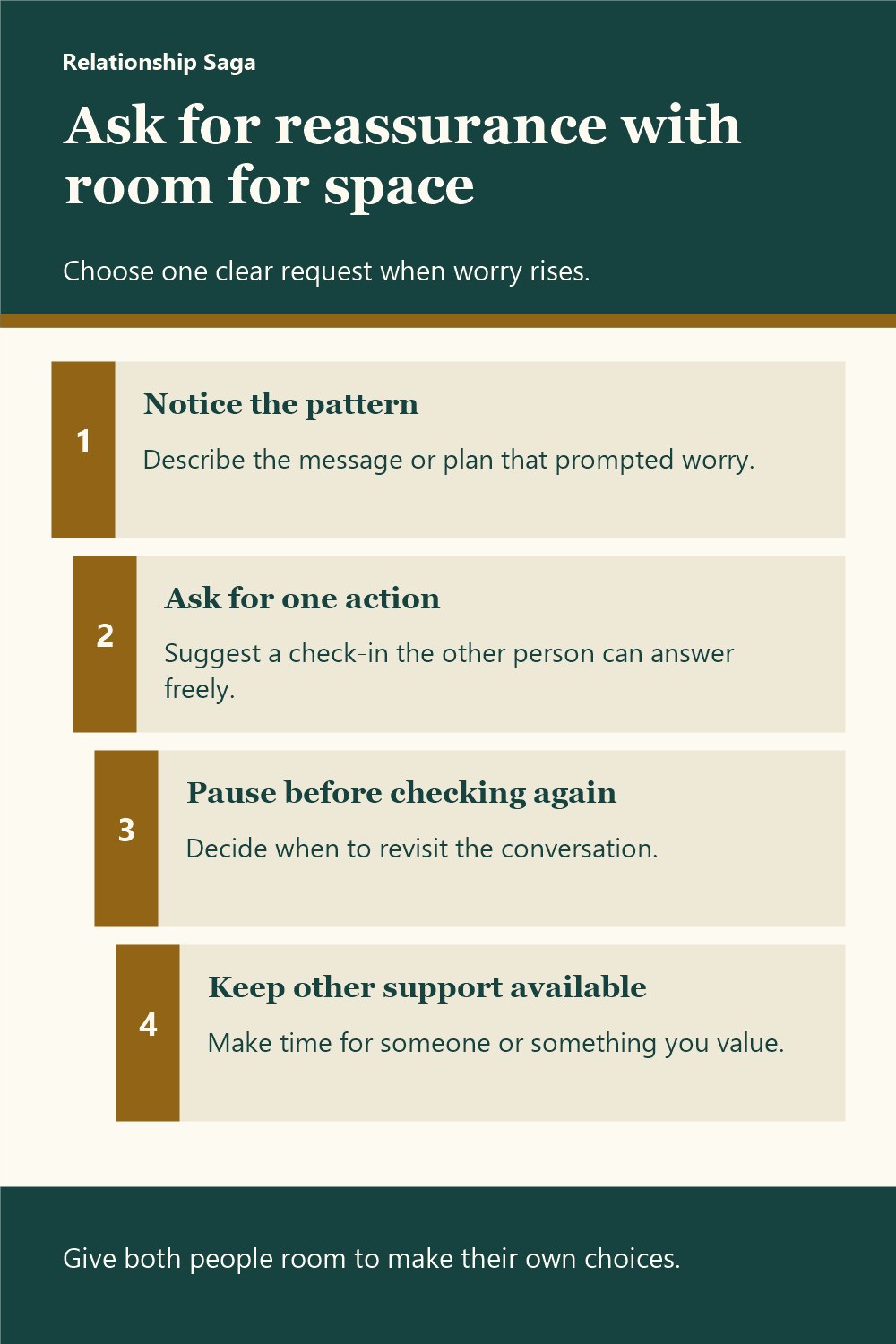
Ask for reassurance with room for space Choose one clear request when worry rises.
- Notice the pattern Describe the message or plan that prompted worry.
- Ask for one action Suggest a check-in the other person can answer freely.
- Pause before checking again Decide when to revisit the conversation.
- Keep other support available Make time for someone or something you value.
Give both people room to make their own choices.