

After a relationship ends, you may look back and wish you had made some choices differently. Perhaps you stayed longer than you wanted, avoided a difficult conversation or built plans around a future you had not discussed together. Regret can be painful without becoming a verdict on your worth.
Finding love again is one possibility, not a task you must complete to prove you have moved on. You can take time to understand what happened, care for yourself and decide what you want next. A future relationship cannot undo the past, but you can approach new choices with more information.
On this page
1. Make room for regret without calling yourself broken
Missing someone, feeling angry or wishing things had worked out does not mean you are broken. You may grieve the person, the routines you shared and the future you imagined. You do not have to decide that heartbreak was necessary or secretly the best thing that ever happened.
Try describing one specific regret instead of judging the whole relationship. “I agreed to move before we discussed money” gives you something to consider. “I ruin everything” is a much broader claim and offers little direction. Ask what you knew then, what you know now and what you would want to check next time.
You can learn something without turning every painful experience into a lesson. Keep room for ordinary support too: a meal, some rest, a familiar activity or company that does not require you to analyse the breakup all evening.

2. Separate responsibility from blame
Consider your own actions honestly. If you dismissed a concern, broke an agreement or spoke hurtfully, name the behaviour and what you want to change. An apology can acknowledge the impact without demanding forgiveness, renewed contact or another chance.
Respect an ex-partner’s request for distance. You can write an unsent apology or work on a change without contacting them. Where contact is welcome, a specific acknowledgement is more useful than a long explanation of why you deserve reassurance.
Responsibility has limits. Another person’s dishonesty, coercion or abuse is their responsibility. Being trusting, staying or hoping for improvement does not make you responsible for their behaviour. Nor does a relationship ending prove that either person was worthless: sometimes people want different things or cannot find an arrangement that works.
3. Look for mutual interest and everyday care
You cannot persuade someone into wanting the same relationship you want. Notice whether interest is mutual, whether plans are discussed clearly and whether both people can say no. A clear refusal deserves respect; repeated pursuit is not a way to establish commitment.
Care also has practical limits. A partner may be busy, tired or unable to answer immediately. Constant availability, cuddling or a particular texting routine is not a universal test of love. Talk about what each of you enjoys and what contact is realistic, rather than treating an unstated expectation as a promise.
Look at patterns over time. Do words and actions broadly match? Can you raise a concern without ridicule? Are changes discussed rather than imposed? Warm feelings matter, but they do not replace those ordinary conversations.
4. Plan for ordinary difficulties
A caring relationship can still involve disappointment, disagreements and periods when one person has less energy. The useful question is how you respond together. Can you explain a concern, listen to the answer and agree on something specific to try?
For example: “When our plans change at the last minute, I struggle to arrange childcare. Could we confirm by Wednesday?” The request names a practical effect and leaves room for an answer. If an agreement is repeatedly missed, review whether it is realistic and whether the arrangement is acceptable to you.
The NHS guidance on relationships and wellbeing discusses listening, boundaries and taking a pause when a conversation is difficult to manage calmly. A pause can have a return time so that it does not leave the issue indefinitely unresolved.
Fear, threats, control and violence need a different response from an ordinary disagreement. Prioritise your safety and seek individual support from a trusted person or a local domestic-abuse service. You do not have to confront someone or stay to demonstrate patience.
5. Keep your boundaries while dating
If you choose to date again, use the past to identify a few preferences and limits, rather than a perfect-person checklist. You might want clearer discussion of intentions, more time before combining finances or a pace of physical affection that feels comfortable to both of you.
Consider three questions before making a commitment:
- What have we actually agreed, and what am I assuming?
- Do I feel free to ask a question, disagree or change my mind?
- Does this choice fit my time, responsibilities and other relationships?
Keep friendships, interests and practical independence where you can. A strong connection does not require you to give up every other source of support. You can enjoy getting to know someone while allowing trust and shared plans to develop gradually.
6. Choose the next step you want
You may want to try a short date, take a break from apps or spend time with friends. Choose something that fits your current capacity. There is no deadline for dating again, and staying single does not make the previous relationship a failure you still need to fix.
If regret or distress keeps interfering with sleep, concentration or everyday tasks, consider speaking with a healthcare professional. The National Institute of Mental Health’s self-care guidance describes everyday support and reasons to seek professional help. You can ask for help before you have a complete explanation of what is wrong.
For now, identify one choice you want to make differently and one form of support you can use. Future love remains uncertain, but your next decision can reflect what you need, what you value and what you have learned.
Read the infographic in text
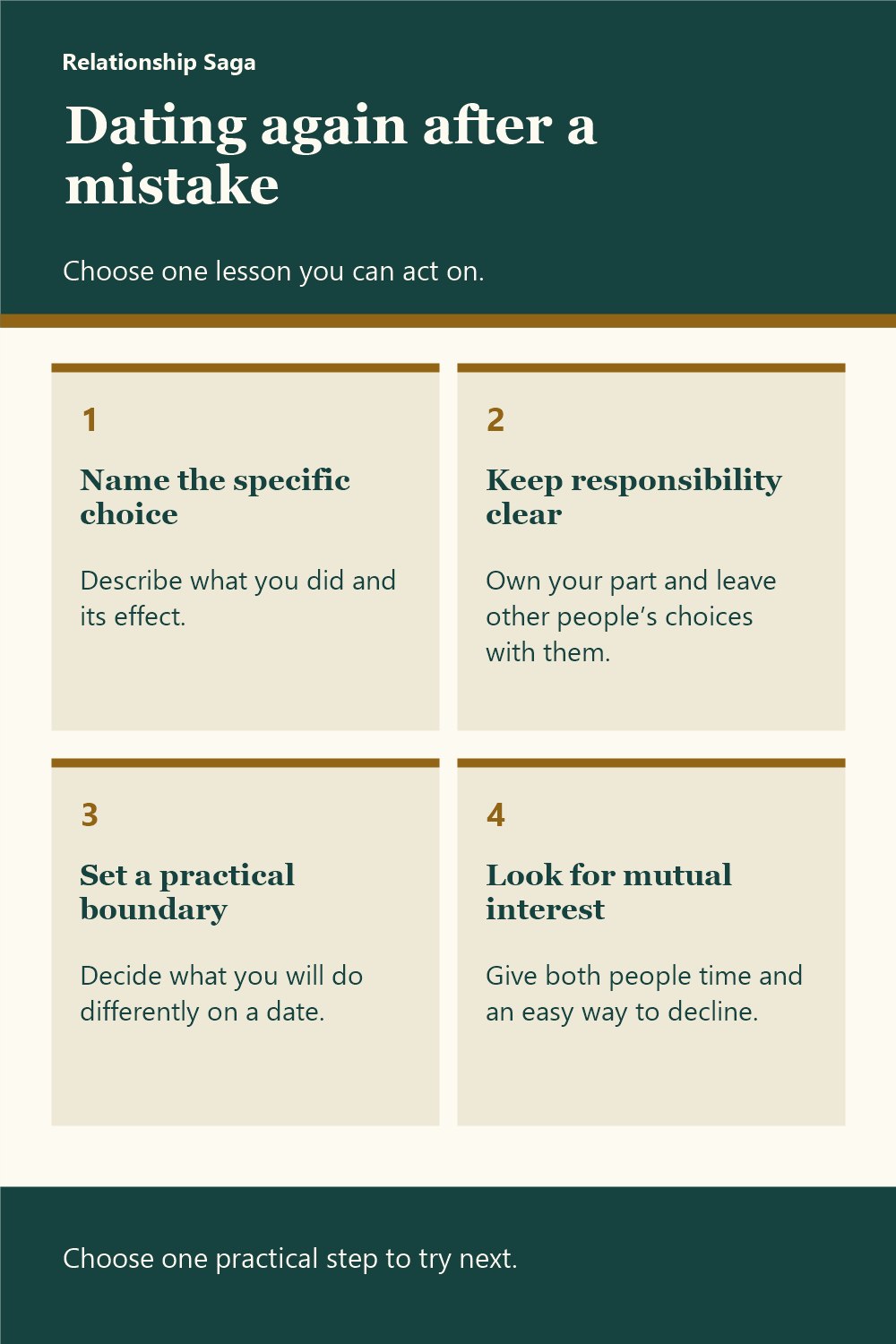
Dating again after a mistake Choose one lesson you can act on.
- Name the specific choice Describe what you did and its effect.
- Keep responsibility clear Own your part and leave other people’s choices with them.
- Set a practical boundary Decide what you will do differently on a date.
- Look for mutual interest Give both people time and an easy way to decline.
Choose one practical step to try next.