

When someone says they love you, you may still wonder what those words mean in your relationship. Attraction, affection, comfort and commitment can overlap, but they do not always develop together. There is no single gesture or feeling that can settle the question for every couple.
A more useful starting point is to ask whether the relationship offers the kind of care, respect and mutual choice you want. You do not have to read another person’s mind, prove that the connection is destined or ignore your own concerns to take love seriously.
On this page

Look at care in everyday life
Affection can be meaningful without proving that two people want the same relationship. Consider what happens around ordinary decisions: making plans, listening to a concern, sharing responsibilities and respecting a refusal. Are promises followed by actions? Can both people say what they need?
Look at the pattern rather than making one moment carry all the evidence. A forgotten errand need not define a relationship; repeated disregard for an important agreement deserves a conversation. You can acknowledge someone’s kindness and still notice a problem that needs attention.
Leave room for your own attraction
There is no correct body type that establishes whether someone is lovable, suitable for commitment or right for you. Attraction is personal, and you do not owe anybody romantic or sexual interest. Equally, being attracted to someone does not establish compatibility or entitle you to change their appearance.
Ask yourself what you enjoy about being with this person, including their company, humour, outlook and the ways you relate. If physical attraction matters to you, be honest with yourself without turning a preference into a judgment about another person’s worth.
You also do not have to accept pressure to exercise, change your weight or provide sex as evidence that you care. Decisions about your body remain yours.
Notice comfort without expecting a cure
A hug, a reassuring message or familiar company may feel comforting when you want it. Ask what helps rather than assuming that every person welcomes touch or wants the same kind of reassurance. “Would you like company, practical help or some quiet?” gives someone room to choose.
Love does not require a partner to make every difficult feeling disappear. Anxiety, grief or other ongoing difficulties can need support beyond the relationship. You can appreciate a caring partner while also seeking help from trusted people or an appropriate professional.
Feeling unsettled does not automatically mean the love is false, and feeling euphoric does not establish that a relationship is healthy. Consider feelings alongside the circumstances and how you are treated.
Ask whether giving is mutual
Giving time and attention can express care. It becomes harder to sustain when one person must continually sacrifice sleep, money, friendships or basic needs to keep the relationship going. Mutuality does not mean keeping an exact score, but each person’s needs should have a place.
Try naming one practical imbalance: “I have arranged our last few visits. Could you plan the next one?” or “I can listen tonight for a little while, then I need to rest.” Notice whether the other person can respond respectfully, including when your limit disappoints them.
Keep space for your own life
Closeness can coexist with separate interests, friendships and time alone. You do not need to give up your identity or share every private conversation to demonstrate devotion. Discuss what contact and time together suit both people, including during busy periods.
The NHS guidance on healthy relationships includes honest communication, boundaries, time for yourself and support outside the relationship. These are useful areas to discuss when expectations differ.
Talk about what you both want
Instead of searching for a hidden sign, ask a direct question when you can talk safely: “What does being together mean to you?” You might also discuss exclusivity, frequency of contact, future plans or whether either of you wants a committed relationship.
Listen to the answer without treating uncertainty as a promise. “I care about you, but I do not want a relationship” can be painful and still be clear information. You can decide that the arrangement does not meet your needs without proving that the person’s feelings are insincere.
Where you both want to continue, turn an expectation into a specific agreement. It is easier to review an agreed plan for visits than to keep guessing what “making more effort” means.
Separate meaning from permanence
A relationship can matter even if it ends. Staying together for a long time is also not, by itself, evidence of safety, respect or satisfaction. Rather than trying to prove that love will last forever, consider whether the relationship is workable and wanted now.
Disagreements can reveal something that needs repair; they should not be dismissed as unimportant just because you love each other. Look for willingness to listen, take responsibility and change the relevant behaviour. An apology does not remove your right to decide what you need next.
Choose a practical next step
Write down one thing you value, one concern and one question you would like to ask. This keeps the conversation focused on your actual relationship rather than an abstract test of “real love”. You may need more time, a clearer agreement, individual support or space to consider leaving.
If you feel frightened, controlled or pressured, seek confidential advice from a local domestic-abuse service before confronting the person or making an announcement. Your safety does not depend on deciding what label to give their feelings.
You are allowed to want a relationship in which affection and respect are both present. The next useful choice is one you can make with the information you have, while keeping your needs and freedom in view.
Read the infographic in text
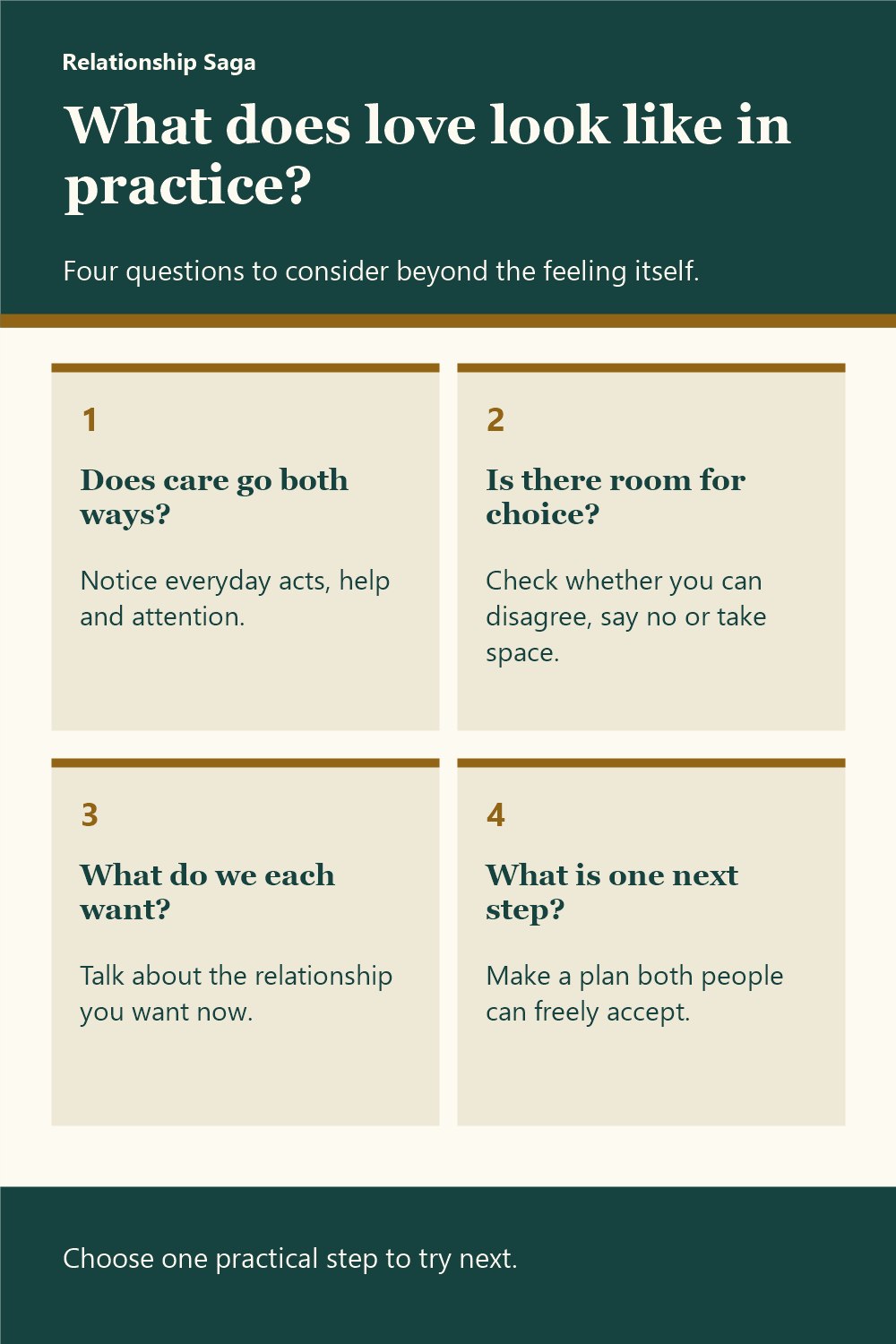
What does love look like in practice? Four questions to consider beyond the feeling itself.
- Does care go both ways? Notice everyday acts, help and attention.
- Is there room for choice? Check whether you can disagree, say no or take space.
- What do we each want? Talk about the relationship you want now.
- What is one next step? Make a plan both people can freely accept.
Choose one practical step to try next.