

Wondering whether a woman loves you can leave you looking for a message in every decision she makes. She may be affectionate, private, busy, uncertain or still working out what she wants. Her gender does not provide a code that lets you read her feelings.
A clearer starting point is the relationship you have: what you each say you want, how you treat each other and whether there is room for both people’s choices. You can ask for clarity while respecting her answer and your own needs.
On this page
Make space for an honest conversation
Choose a time when you can both talk without rushing. Say what you have noticed and what you want to understand: “I care about you, and I am not sure whether we want the same relationship. Could we talk about that?”
Listen to the response without supplying a hidden explanation. If she says she is not ready, does not know or does not want to continue, take that as information about what she can offer now. Past hurt may be part of her story, but you cannot assume it is the reason for her answer.
You can ask a follow-up question when clarification is welcome. You do not have to interrogate her, demand a declaration or keep trying to prove that she feels something she has not chosen to say.
Discuss what love means in practice
People may use “I love you” while having different expectations about time together, exclusivity or the future. Talk about the parts that matter to your decisions. You might ask how often you want to see each other or whether you are both looking for commitment.
Plans about children, living arrangements or money need their own conversations. Wanting children does not explain every woman’s approach to love, and not wanting them does not make a relationship less serious. Find out what this particular person wants.
Keep room for your preferences too. If you want regular time together, describe a workable arrangement rather than asking her to demonstrate love through unlimited availability.
Keep independence and boundaries
Love does not require changing every goal, abandoning friendships or putting one partner first in every situation. You can care for each other while keeping separate interests, privacy and responsibilities.
Disagreement can involve a practical concern or a different preference. It does not automatically mean she is testing you, trying to improve you or trying to gain power. Ask what the disagreement is about and decide whether you can address it respectfully.
Both people should remain free to decline affection, a plan or a conversation at that moment. A boundary is not proof that love is absent. Consider whether each person’s limits can be expressed without pressure or retaliation.
Consider behaviour without using tests
Remembering something important, showing interest or offering help may be meaningful acts of care. Ask what feels supportive to each of you rather than setting a checklist that someone must complete to prove love.
Do not provoke jealousy or compare her reaction with a stereotype. Monitoring you, restricting friendships or demanding constant reassurance does not become acceptable because someone calls it love. Similarly, you do not need to monitor her to establish whether she cares.
The love is respect relationship spectrum can help you consider patterns of behaviour and routes to support. Look at how the relationship functions, including whether you feel free to make choices.
Choose from the relationship available now
After talking, consider what is clear and what remains uncertain. You might agree on a practical change, keep getting to know each other, take space or decide that your needs do not fit. Her feelings and your decision do not have to be reduced to a verdict about who is a good person.
If the same question keeps returning, ask whether there is new information or whether you are waiting for the answer to change. You can make a decision without total certainty about someone else’s inner life. If you fear a threatening response, seek individual safety support before confronting them.
Read the infographic in text
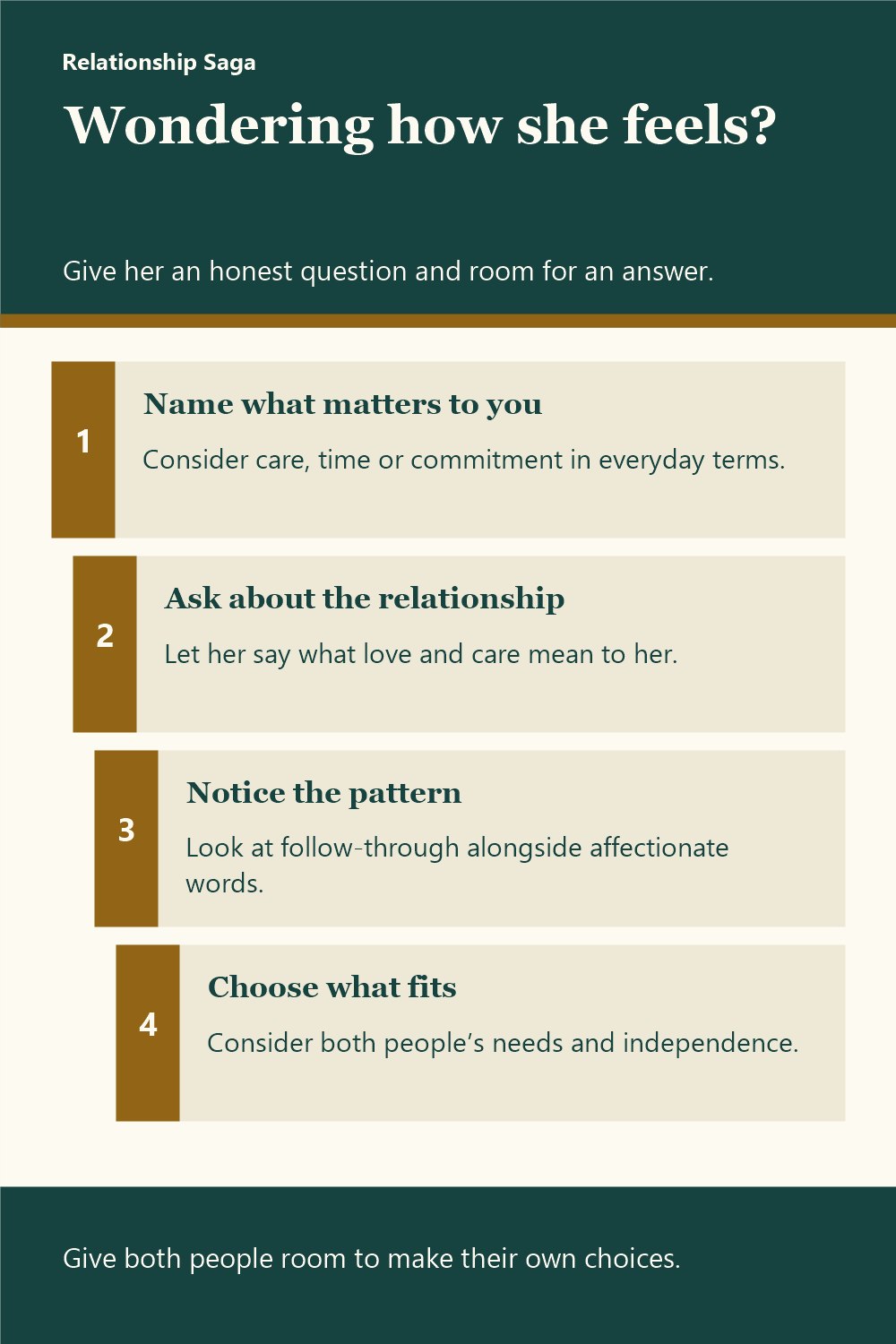
Wondering how she feels? Give her an honest question and room for an answer.
- Name what matters to you Consider care, time or commitment in everyday terms.
- Ask about the relationship Let her say what love and care mean to her.
- Notice the pattern Look at follow-through alongside affectionate words.
- Choose what fits Consider both people’s needs and independence.
Give both people room to make their own choices.