

After a partner breaks your trust, you may want time to decide whether to try again. Start with three questions. What happened? Has your partner taken responsibility? Can you set a boundary without fear of punishment?
A second chance can begin with a conversation or a limited agreement. You can also decide to pause or end the relationship. A practical plan for housing, money or parenting can give you breathing room while you consider your options.
On this page
- Check whether you both want to try
- Give forgiveness its own timeline
- Look at the action and its impact
- Take shared responsibilities seriously
- Listen for a specific apology
- See whether hard conversations feel safe
- Take repeated betrayals into account
- Notice how they respond to reasonable questions
- Get private support when you feel unsafe
Check whether you both want to try
If you feel safe, ask what each of you hopes will change. Be specific about the behavior that broke trust. Agree on one next step and a time to check how it went. Each of you needs room to say no or change your mind.
Give forgiveness its own timeline
You may feel hurt, relieved, angry or uncertain on different days. Let yourself process those feelings before making promises. You can choose what forgiveness means to you and make a separate decision about contact or reconciliation.
Look at the action and its impact
A one-time lapse can still cause serious harm. Consider what your partner did, what it cost you and whether there was an agreement they understood. Ask what they will do differently the next time the same pressure comes up.
Take shared responsibilities seriously
Children, a home and shared expenses are reasons to think through logistics. List what needs attention this week and what can wait. If you need help with childcare, money or a place to stay, ask someone you trust or a relevant local service.
Listen for a specific apology
A meaningful apology names the action and its effect and is followed by repair. For example, “I hid the spending and left you with bills you hadn’t agreed to. I will show you the statements and make a repayment plan with you.” Then watch whether the follow-through continues when it is inconvenient.
See whether hard conversations feel safe
If you can speak freely, set aside a short time for one issue and agree to return to it after a break. When a partner punishes honesty or uses what you share against you, consider private support first. The National Domestic Violence Hotline explains why couples counseling can be unsafe during abuse.
Take repeated betrayals into account
Compare what happened after the last promise with what is happening now. If the same agreement keeps being broken, you can say what you need and follow through on your own boundary. You can decide that repeated harm is enough information.
Notice how they respond to reasonable questions
Ask for the information you need to make decisions that affect you. Changing explanations and blame can make trust harder to rebuild. Agree on the kind of transparency you both understand, and keep control of your own passwords, accounts and support network.
Get private support when you feel unsafe
Threats, intimidation, control over your money, stalking, sexual coercion or violence warrant attention to safety. If a conversation could put you in danger, you can skip it. From a safer device if possible, contact a local domestic abuse service or use the U.S. National Domestic Violence Hotline’s safety-planning resources. In immediate danger, contact local emergency services if you can do so safely.
Read the infographic in text
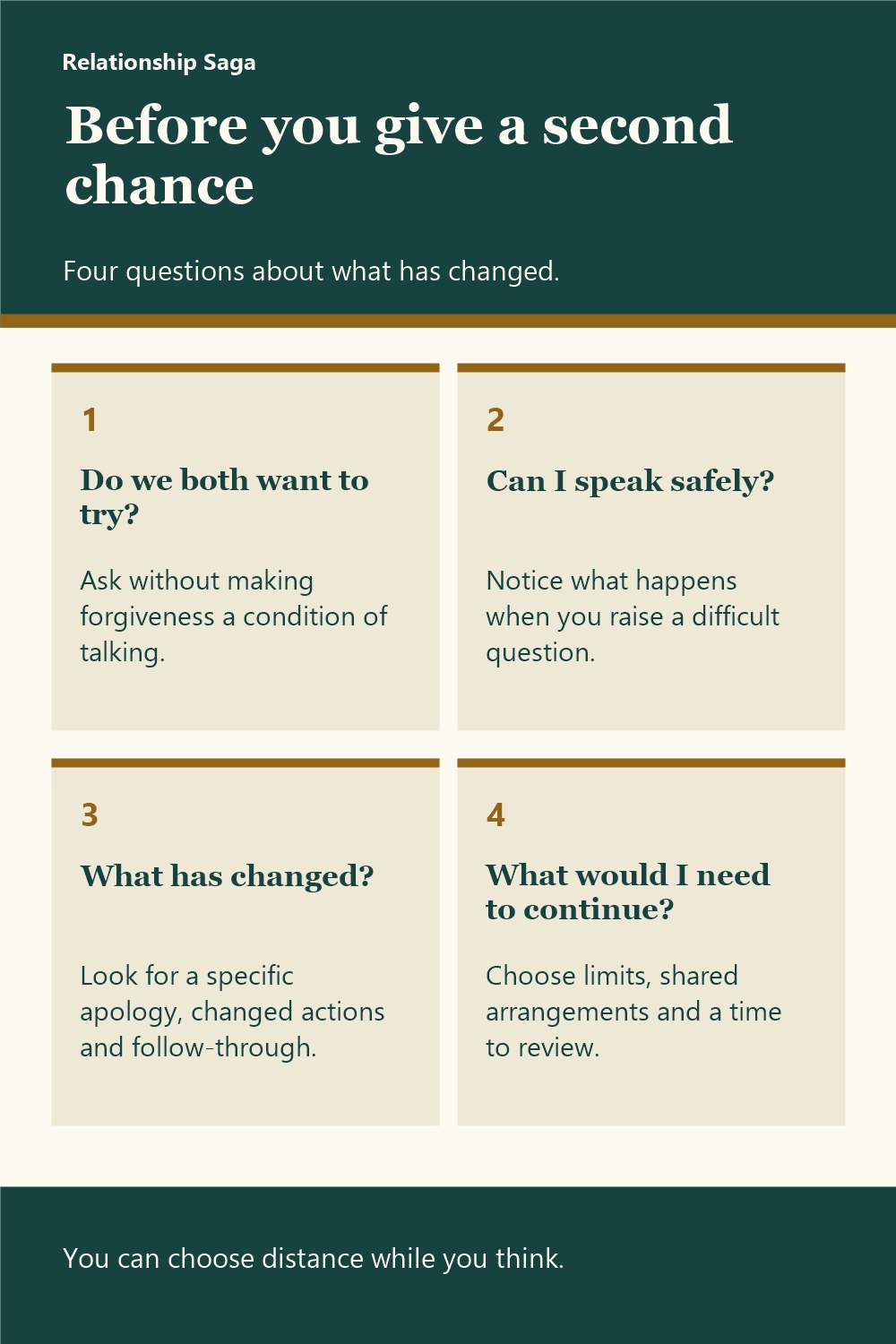
Before you give a second chance Four questions about what has changed.
- Do we both want to try? Ask without making forgiveness a condition of talking.
- Can I speak safely? Notice what happens when you raise a difficult question.
- What has changed? Look for a specific apology, changed actions and follow-through.
- What would I need to continue? Choose limits, shared arrangements and a time to review.
You can choose distance while you think.